How to Spend One Day in Trier: Top Things to Do and See
Looking for the best things to do in Trier?
This small city in western Germany is often skipped over for bigger destinations, but it’s one of those places that surprises you in the best way. With its Roman ruins, colourful old town, and relaxed pace, Trier is easy to explore in one day and perfect for a short stop.
We visited in winter, mostly to check out the Christmas markets, but it was the Roman ruins—not the mulled wine—that really stuck with us. Even in the cold, there was plenty of things to do, but we’re already planning a return trip in warmer weather.
Whether you’re stopping in on a road trip, visiting from Luxembourg, or just curious about what makes Germany’s oldest city worth a visit, here’s what not to miss—especially if you’re short on time. From ancient city gates and underground tunnels to riverside views and wide-open plazas, Trier is easy to explore in a day, and a lot more fun than we expected.
Best Things to Do in Trier, Germany
Whether you’re spending a full day or just a few hours, here’s what we suggest doing, to best discover the city’s history, charm, and easygoing vibe. Everything is walkable, so you can take your time and explore at your own pace.

1. Visit Porta Nigra
Trier’s most iconic landmark, Porta Nigra is a massive Roman gate that’s been standing for nearly 2,000 years. It’s one of the best-preserved Roman structures in Germany and part of Trier’s UNESCO World Heritage designation.
You’ll spot it right away as you enter the old town, and yes—you can go inside. Winding stone staircases lead to upper levels and open walkways with views over the city. It’s not a huge site, but it’s fun to explore—especially for kids who enjoy hidden corners, tunnels, and a bit of climbing.
We didn’t get a chance to go inside during our visit, but even from the outside, it’s impressive and absolutely worth a stop. If you do go in, plan for about 20 to 30 minutes.
🕘 Opening hours: Daily from 9 a.m., with closing times varying by season (typically between 4 and 6 p.m.)
💶 Admission: €6 for adults, €3 for kids aged 6–12, with family tickets available
🔗 Check current hours and prices here
🎟️ Consider the Antikencard if you’re planning to visit more than one Roman site in Trier
2. Stroll Through the Hauptmarkt
Just a short walk from Porta Nigra, Trier’s Hauptmarkt is the main square in the old town. Surrounded by historic buildings, narrow cobblestone streets, and the distinctive St. Peter’s Fountain in the centre, it’s the heart of the city.
In the summer, it would be a great place to stop for a snack, a warm drink, or just take a break while exploring. We visited in December, when the square was filled with Christmas market stalls, and somehow we kept ending up back here.
Like so many main squares in Europe, it’s the kind of place you naturally return to—whether you’re grabbing food, meeting up, or just passing through on your way to the next stop.

3. See the Trier Cathedral & Liebfrauenkirche
Just off the Hauptmarkt, you’ll find two of Trier’s most important churches—Trier Cathedral (Dom St. Peter) and Liebfrauenkirche (Church of Our Lady)—right next to each other.
The Trier Cathedral is the oldest in Germany, with Roman foundations and a mix of styles added over the centuries. It’s big, bold, and full of details, from heavy stone arches to relics and sculptures.
Right next door, Liebfrauenkirche is smaller but just as striking, with its Gothic architecture and unique circular layout.
Both are free to enter and don’t take long to walk through. Even if you’re not usually into churches, they’re worth a quick visit—and easy to combine with your time in the Hauptmarkt.

4. See the Roman Amphitheatre
Just outside the old town, Trier’s Roman Amphitheatre is another good Roman ruin to explore, especially if you’re visiting with kids. Built into the side of a hill and once holding up to 20,000 spectators, it’s surprisingly well-preserved and easy to walk through.
You can cross the arena floor, climb the stone steps, and even head underground to check out the tunnels where gladiators and animals once waited before entering the ring. It reminded us a bit of the Roman amphitheatre in Pula, Croatia. It’s smaller, and without the impressive columns, but with the same open layout and the chance to explore above and below ground.
The amphitheatre is included with the Antikencard, or you can pay a small entry fee at the gate. Expect to spend at least 20–30 minutes here, or longer if your kids love running up and down ancient staircases like mine do.
🕘 Opening hours: Daily from 9 a.m.; seasonal closing times (4–6 p.m.)
💶 Admission: €6 for adults; free for kids under 6
🎟️ Included with the Antikencard
Visiting Multiple Roman Sites?
The Antikencard is a great option if you’re planning to visit more than one Roman site in Trier. It covers entry for 1 adult and up to 4 children and can be used across several days.
- Antikencard Basic: €18 for 2 sites
- Antikencard Premium: €25 for 4 sites (plus museum access)
You can buy the pass at participating sites, the tourist info centre or online.
5. Explore the Kaiserthermen (Imperial Baths)
Trier has several Roman bath sites, but the Kaiserthermen, which was once planned as one of the largest complexes in the Roman Empire, are the most impressive to visit. What’s left today is mostly ruins, but you can still walk through underground corridors and get a sense of the scale.
This ended up being the highlight for my kids. Even though it was raining, they loved wandering through the tunnels—and I swear they made me walk through some of them more than once. Between the damp stone walls and the slightly spooky underground feel, it was way more fun than they expected.

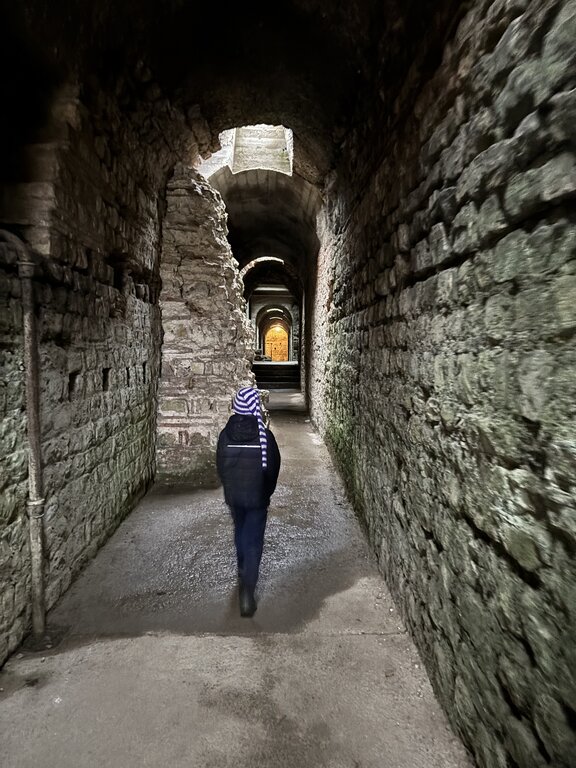
It doesn’t take long to visit, but it’s a great mix of history and hands-on exploring. It’s included in the Antikencard, which is a great idea to get if you’re visiting multiple Roman sites in Trier, like Porta Nigra and the amphitheatre.
🕘 Opening hours: Daily from 9 a.m.; closing times vary by season (usually 4–6 p.m.)
💶 Admission: €6 for adults, €3 for kids aged 6–12, family rates available
🎟️ Included with the Antikencard
6. Relax at the Palastgarten
Right next to the Kaiserthermen, the Palastgarten is a formal garden behind Trier’s striking pink Electoral Palace. With wide gravel paths, manicured lawns, and rows of statues, it’s a peaceful place to take a break or let the kids run around a bit between sightseeing stops.
We walked through briefly, but since it was chilly and raining, we didn’t stay long. If the weather had been better, my boys would’ve been kicking a soccer ball around for sure. And if you’re visiting on a dry day, there’s a great playground right next to the Electoral palace, which makes for a perfect break between more structured stops.
Especially if you’re visiting in the warmer weather, the Palastgarten is a nice spot to slow down, stretch your legs, or just let kids burn off a bit of energy.
7. Check out the Trier Toy Museum (Spielzeugmuseum)
We didn’t get a chance to visit the Trier Toy Museum, but honestly—I kind of wish we had. It’s a small museum near the city centre with a collection of vintage toys, games, trains, and dolls, plus some interactive displays.
One thing that caught my eye was the scavenger-style activity for kids, with questions to answer as they explore the exhibits. Things like “How many monkeys are in the clown orchestra?” or “Where does the name ‘teddy bear’ come from?” make it feel more hands-on and give kids a reason to slow down and actually look at the displays.
My kids love this kind of challenge, and it’s the sort of thing that turns a museum visit into something fun and memorable. If yours are the same—or you’re looking for a low-key indoor activity—it’s definitely worth considering, especially on a rainy day.
🕘 Opening hours: Tuesday to Sunday, 11 am – 7 pm (closed Mondays)
💶 Admission: Adults: €5, Youths (11–18): €2.50, Children (4–10): €2, Family: €13
8. Stop By the Karl Marx House
Even if you’re not a history buff, the Karl Marx House is an easy and interesting stop—especially if you’re already nearby. It’s the birthplace of Karl Marx, the 19th-century philosopher and economist best known for developing the ideas behind socialism and communism.

Today, the house is a museum with exhibits about his life, his writings, and how his ideas have influenced politics and society around the world. We didn’t go inside the museum—I figured the exhibits might be a bit much for my kids. But we did stop by to check out the outside of the house, and had a bit of a history lesson on who he was, both at the house and again at the Karl Marx statue near Porta Nigra. (Mom, he must be important if there’s a statue of him!)
🕘 Opening hours: Daily from 10 am – 6 pm (closed Mondays)
💶 Admission: Adults: €5 · Children/Youths (6–18): €3.50 · Family ticket: €9
📍 Location: Brückenstraße 10, just a few minutes’ walk from the city centre
9. Walk Along the Moselle River
If you have a bit of extra time, or just want a quieter moment between sightseeing stops, a walk along the Moselle River is a nice way to slow down and see a different side of the city. The riverfront is just a few minutes from the old town, and you’ll find wide paths, benches, and views of old bridges and river traffic.
There’s no specifc sights to see, but it’s a great place for a break, a snack, or letting the kids run around a bit. We only spent a short time here since it was cold and drizzly, but I’d love to come back in warmer weather. In the warmer months, this would be a great spot to cycle or run.
It’s also where you’ll find the historic harbour cranes, which are fun to check out if your kids are into old machines or like climbing up to see how things work.
10. Try a Glass of Moselle Wine
Trier is right in the heart of the Moselle wine region, best known for its crisp white wines—especially Riesling. Even if you’re not doing a full tasting tour, it’s worth trying a glass while you’re here. Many cafés and restaurants in the old town serve local wines by the glass, and it’s a nice way to sample something from the region.
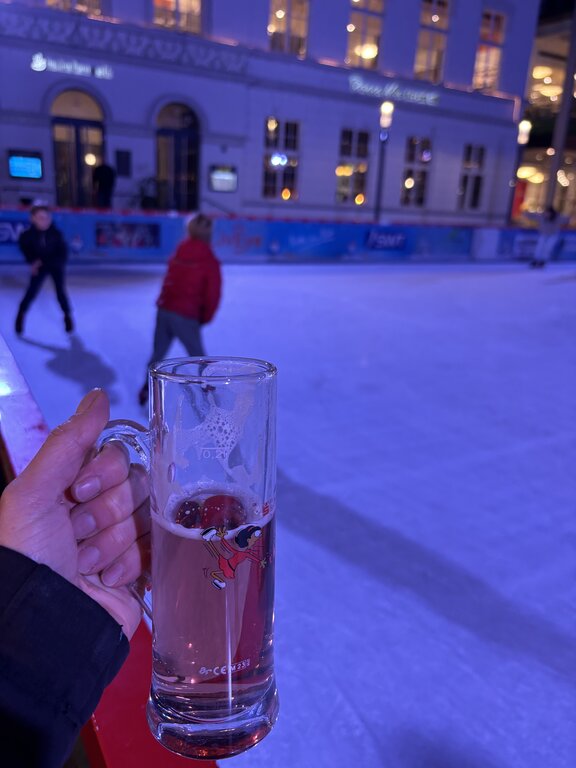
We didn’t do a full tasting (this wasn’t that kind of trip), but I did enjoy a glass with dinner – and a few glasses of mulled wine at the Christmas markets, which are also made with local wine. I’d love to come back in the summer and visit a few of the nearby vineyards when they’re open for tastings and tours.
What to Eat in Trier
Since we visited during the Christmas season, we mostly ate on the go—bratwurst, potato pancakes, and lots of mulled wine from the market stalls. But Trier and the surrounding Moselle region also have a few specialties worth trying if you’re visiting any time of year.
Here are a few local foods and drinks to look out for:
- Mosel Riesling – crisp white wine, often dry or slightly sweet
- Zwiebelkuchen – savoury onion pie often served with wine
- Sauerbraten – marinated roast (typically beef) with a sweet-sour sauce
- Rievkooche – potato pancakes, usually served with applesauce
- Tresterfleisch – pork cooked with grape pomace, unique to wine regions
- Viez – a local apple cider-style drink, more tart than sweet
Even if you’re just grabbing a quick lunch or having a glass of wine with dinner, you’ll likely come across a few of these regional favourites.
How to Get to Trier
Trier is easy to reach by train or car, making it a convenient stop whether you’re coming from within Germany or neighbouring Luxembourg.
- By Train: Trier is well-connected by regional trains, with direct routes from cities like Koblenz, Saarbrücken, and Luxembourg City. The main station (Trier Hbf) is about a 10-minute walk from the old town.
- By Car: If you’re road tripping through western Germany or the Moselle Valley, Trier is an easy stop. There are several parking garages near the old town—just follow the “Parkhaus” signs.
- From Luxembourg: Trier is an easy day trip from Luxembourg City, with regular trains and buses running between the two in under an hour.
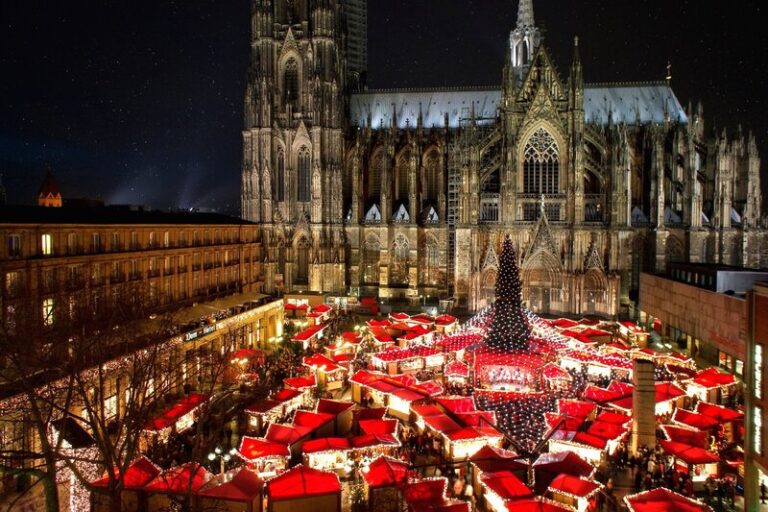
We were coming from the Cologne Christmas Markets, so we took the train with a quick connection in Koblenz, then continued on to Luxembourg the next day. Staying overnight gave us plenty of time to explore without feeling rushed—but if you’re short on time, Trier also works well as a day trip.

Our Take on What to Do in Trier, Germany
Trier might not be one of the most talked-about cities in Germany, but it ended up being one of the highlights of our trip. We originally came for the Christmas markets, but quickly realized there was way more to see—especially with all the Roman ruins right in the middle of the city.
Even in the middle of winter, Trier was easy to explore, and the compact layout made it manageable with kids. We only stayed one night, but it felt like the right amount of time to enjoy the main sights without feeling rushed. If you’re planning a trip through western Germany or the Moselle region, Trier is absolutely worth a stop—whether you’re visiting in December or planning a return trip in warmer weather (like we are).
Looking to Explore More of the Area?
Trier is a great base or stopover if you’re exploring western Germany or heading into Luxembourg. If you’re visiting in December, Trier’s Christmas markets are some of the best in Germany (yes, really!), and nearby, Luxembourg’s markets are worth seeing too.
But even outside the holiday season, Luxembourg is a fun and easy destination just an hour away by train, with plenty of things to do if you’re looking to spend a few days nearby.
If you’re staying in Germany, cities like Cologne and Düsseldorf are easy to reach by train, and full of family-friendly things to do. And if you need more inspiration, check out our guide to the best places to visit in Germany with kids.